Search What's This Cloud

Cirrocumulus Clouds:High-altitude Cloudlets

Cirrocumulus clouds are high-level patches or layers made of very small white cloudlets arranged in grains, ripples, or rows. They usually produce no precipitation at the ground, though changing or increasing patches can reveal moisture and instability high in the atmosphere.

Cirrocumulus floccus (Cc flo)

How to identify cirrocumulus clouds

Small, flakey, and white high-altitude cumulus heaps and patches

Cirrocumulus clouds are thin cloud patches found high in the troposphere and are the only cloud found here that has cloud heap characteristics. Because cirrocumulus clouds are so high in altitude, the cloud heaps take on what can be described as a ‘grain of rice’ appearance. Take note when you see them because along with cumulonimbus, cirrocumulus clouds are the least seen among the ten main cloud types.

Unlike cirrus and cirrostratus clouds, cirrocumulus clouds don’t typically produce sun halos, though they are capable of iridescence and coronas on the rare occasion. Additionally, these are the only clouds in the high level that cannot be found in the fibrous form. If you see a cirrocumulus cloud, the chances are good that there are cirrus and/or cirrostratus clouds nearby or even adjacent.

Similar to altocumulus clouds, cirrocumulus can also take on a mackerel sky effect, resembling fish scales. If you’re lucky enough to see a mackerel sky at sunset, you’re in for a treat.

Is it cirrocumulus? Check these four clues

Judge the apparent size, shading, and pattern together. Several lower cloud types can also form rows or ripples.

  1. Tiny cloudlets

    The individual grains look very small from the ground, often smaller than a finger held at arm's length.

  2. Little gray shading

    Most elements appear white because the layer is high and relatively thin.

  3. Repeated pattern

    Look for organized ripples, rows, scales, or a fine mackerel-sky texture.

  4. High-level setting

    The field often appears delicate and distant, sometimes mixed with cirrus or cirrostratus.

Read the pattern across a cirrocumulus field

The arrangement of the cloudlets shows whether the high layer is smooth, wave-shaped, or locally unstable.

  1. 1Widespread fine layerStratiformisHigh moisture presentMany small cloudlets spread through a thin sheet or patch.Open the field note →
  2. 2Parallel ripplesUndulatusWaves aloftRegular bands or waves reveal oscillation or wind differences in the high layer.Open the field note →
  3. 3Tiny turreted topsCastellanusInstability aloftSmall towers rising from a shared base signal convection at high altitude.Open the field note →
  4. 4Tufts with ragged basesFloccusVirga may appearRounded tufts with trailing streaks show cloud particles falling into drier air.Open the field note →

Classifying cirrocumulus clouds beyond the cloud type

Begin with cirrocumulus as the cloud type, then add species, varieties, supplementary features, accessory clouds, or origin terms only when each detail is visible. Every illustration below links to its complete field note.

Cirrocumulus cloud species

4 cloud species are associated with cirrocumulus clouds. Open any field note to compare the illustration with photographs and identification guidance.

Cirrocumulus cloud varieties

2 cloud varieties are associated with cirrocumulus clouds. Open any field note to compare the illustration with photographs and identification guidance.

Cirrocumulus supplementary features

3 supplementary features are associated with cirrocumulus clouds. Open any field note to compare the illustration with photographs and identification guidance.

Cirrocumulus other clouds

1 other cloud is associated with cirrocumulus clouds. Open any field note to compare the illustration with photographs and identification guidance.

Compare cirrocumulus with similar cloud types

Use cloud-base level, texture, structure, and sky coverage together before choosing the closest match.

Cirrocumulus vs. altocumulus

Cirrocumulus has very small, mostly white high-level grains. Altocumulus elements look larger, lower, and more likely to have gray shading.

Best clueIf the elements show obvious shading or look larger than a finger at arm's length, favor altocumulus.

Illustration of cirrocumulus clouds
Cirrocumulus
Illustration of altocumulus clouds
Altocumulus

Cirrocumulus vs. cirrus

Cirrocumulus repeats as grains or ripples. Cirrus separates into fibrous streaks, hooks, feathers, or tufts.

Best clueA regular field of cloudlets favors cirrocumulus; flowing hair-like strands favor cirrus.

Illustration of cirrocumulus clouds
Cirrocumulus
Illustration of cirrus clouds
Cirrus
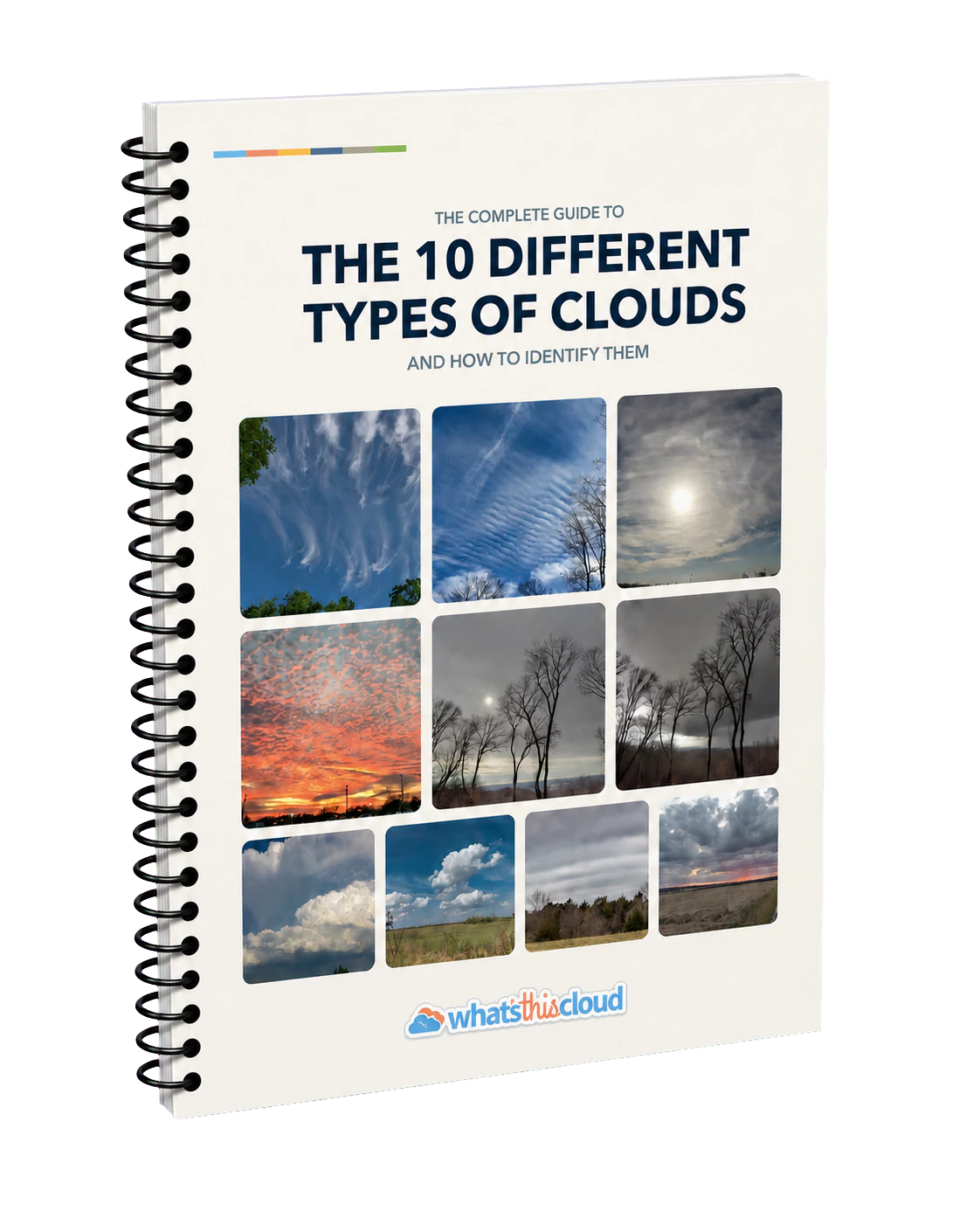
Cover of the free cloud types ebook

Learn cloud identification with a free 80+ page ebook

Take the visual guide with you. The ebook explains the ten types of clouds with original photographs, illustrations, identification tips, and comparisons between similar clouds.

Download Here